




Choosing between a hair system and a hair transplant comes down mostly to two things: how much donor hair you have, and how far your hair loss has gone. A transplant moves your own hair once, takes about a year to show, and then needs no upkeep. A hair system gives you full density on the day of fitting at any stage of hair loss, but it has to be re-bonded every few weeks and replaced every 6 months to 2 years.
We fit hair systems for a living, so read this with that in mind. We still tell people when a transplant would suit them better.
Do you have enough donor hair for a hair transplant?
A transplant does not create hair. It takes follicles from the donor area, the band at the back and sides of the head that usually survives male-pattern hair loss, and moves them to the front and top. That hair tends to keep growing in its new place, which is why a good transplant lasts.
The limit is supply. The donor area is finite, and every graft taken leaves it slightly thinner. Take too many and the back of the head starts to look see-through, which is hard to hide and cannot be undone.
How far your donor hair stretches depends on its density, the thickness of each hair (coarse hair covers more scalp than fine), the contrast between hair and skin (dark hair on pale skin needs more grafts to look full), and how stable the donor hair is.
A hair system uses no donor hair, so this limit does not apply to it.
Which Norwood stage suits a transplant, and which suits a hair system?
The Norwood scale grades male hair loss from 1 (no real loss) to 7 (only a horseshoe of hair left at the back and sides).
- Norwood 2–3: a receding hairline or temples. A transplant usually works well here once the loss has slowed. A hair system is possible, but it means keeping the area under the base shaved, which is a big commitment for a small problem.
- Norwood 4–5: the front and top are thinning and the crown is opening. A transplant can rebuild the front and part of the top, and the crown is often left lighter. This is where the two options are closest, and where your donor area decides it.
- Norwood 6–7: the bald area is larger than any donor area can cover at a density that looks full. A surgeon can frame the face with a hairline and accept a thin top. A hair system covers the whole area at the density you choose.
Age matters too. Hair loss in your early twenties is often still moving. A hairline transplanted at 23 can end up as an island of hair if the hair behind it keeps receding, which is why many surgeons advise waiting. A hair system can come off at any time while your pattern settles.
Hair system vs hair transplant: side-by-side comparison
| Factor | Hair system | Hair transplant |
|---|---|---|
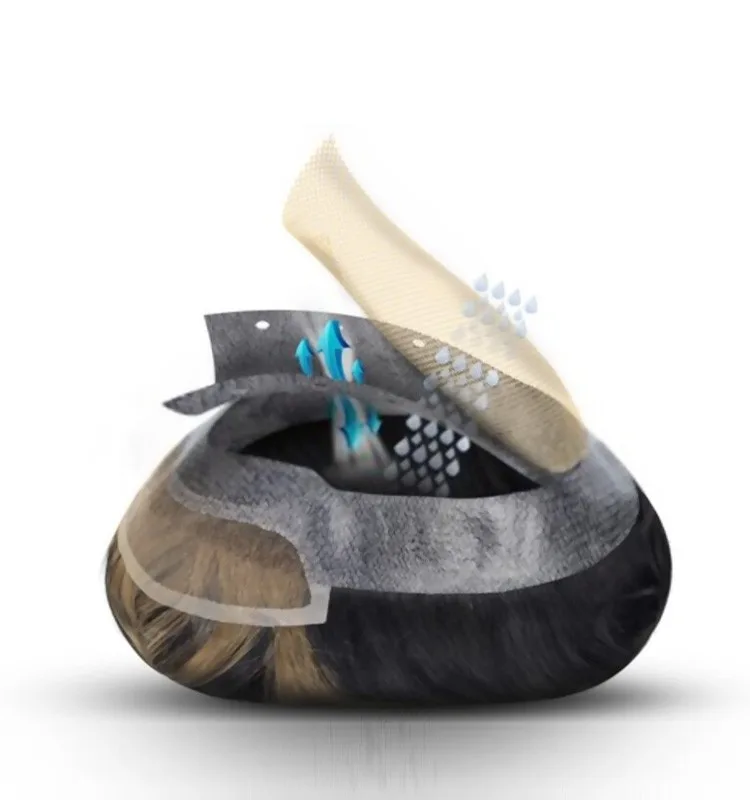
| What it is | Human hair on a thin base, bonded to the scalp | Surgery that moves your own follicles |
| Donor hair needed | None | Yes, and the supply is limited |
| Time to result | Same day; the fitting takes 1–2 hours | Most of the result at 6–12 months |
| Density | Whatever you choose | Limited by the donor area |
| Upkeep | Re-bonding every 2–5 weeks, washing at home | Normal haircuts; often medication for the remaining hair |
| Lifespan | One system lasts 6 months to 2 years | Transplanted hair is usually permanent |
| Cost pattern | Lower first cost, recurring for as long as you wear it | High first cost, little afterwards |
| Main risks | Skin irritation; visible edges if badly fitted or overdue | Surgical risks, scarring, poor graft survival |
| Reversible | Yes | No |
What does each option cost over 5 to 10 years?
We don't print prices: a hair system's price depends on the base, the size of the area, the hair quality and how much is made to order. What we can show is how the costs are built.
A transplant is one large bill. Some people need a second session years later if their loss continues, and many surgeons recommend ongoing medication to protect the hair that was not transplanted. After that, the cost is a normal haircut.
A hair system has a lower first bill and then three running costs:
- Replacement systems. At one every 6 months to 2 years, ten years means somewhere between 5 and 20 systems.
- Maintenance. A visit every 2–5 weeks adds up to roughly 10 to 26 visits a year.
- Supplies. Tape or adhesive, remover and shampoo, especially if you do your own maintenance.
Put the figures from your quotes into that and multiply by the years. Done honestly, the ten-year total for a hair system is usually higher than for a single transplant. What the difference buys is density and a hairline that a transplant cannot give at advanced stages, with no surgery involved.
How long until each one looks like your own hair?
A hair system is finished when you leave. The fitting takes 1–2 hours, the hair is cut into yours in the chair, and there is no recovery period.
A transplant is slower. Expect redness and small scabs for a week or two. The transplanted hairs shed within the first weeks, new growth starts around the third or fourth month, and most of the result shows between 6 and 12 months. If you have a wedding or a new job in two months, only one of these options will be ready.
What upkeep does a hair system need compared with transplanted hair?
Transplanted hair is your own: you wash, cut and colour it like the rest.
A hair system is a routine. Every 2–5 weeks it is removed with a solvent, the base and scalp are cleaned, and it is bonded again. Your own hair at the sides grows about a centimetre a month and the system's hair does not grow at all, so the sides need trimming to keep the blend. The skin under the base is kept shaved or clipped very short so the bond holds. Between visits you wash it once or twice a week with a sulphate-free shampoo.
Skip that routine and it shows: lifting edges, a dull and matted nape, colour that no longer matches. Our guide on how long a hair system lasts covers the schedule in detail.
What are the risks of a hair system and a hair transplant?
A transplant is surgery under local anaesthetic. The usual risks are infection, swelling, temporary numbness, shock loss (native hair near the grafts shedding for a few months), poor graft survival and scarring. FUT leaves a linear scar across the back of the head; FUE leaves small dot scars that can show with a very short cut. Results depend heavily on the surgeon.
A hair system carries no surgical risk. Its risks are on the skin and in the appearance:
- irritation from an adhesive or tape, uncommon with hypoallergenic medical products but possible, so mention any skin allergies at the analysis
- itching or inflamed follicles if the scalp is not cleaned at each maintenance visit
- a visible hairline or shine if the base, colour or fit is wrong
- strain on your own hair if clips sit in the same places for too long
There is one more that people rarely mention: dependence. The day you stop wearing a system, your hair loss is back exactly as it was.
Who should choose a hair transplant, and who a hair system?
A transplant is usually the better choice if
- your donor area is dense and stable
- you are around Norwood 2–5 and your loss has slowed
- you are happy with moderate density
- you want no long-term routine and can wait a year for the result
A hair system is usually the better choice if
- your donor area is thin, or has already been used by earlier transplants
- you are at Norwood 6–7, or your hair loss comes from alopecia areata, scarring, burns or chemotherapy
- you want full density and a defined hairline
- you cannot have surgery, or do not want it
- you want the result now and accept the recurring cost and routine
Over a lifetime the two are not exclusive. Wearing a system uses no donor hair, so a transplant stays possible later. Some people come to a hair system after a transplant that gave less density than they hoped; once the scalp has fully healed and the surgeon agrees, a system can be worn over it. You can see finished systems on our before and after page.
If you are not sure which group you belong to, send clear photos of your hairline, top, crown and the back of your head to Neo Hair on WhatsApp for a free hair analysis. If a transplant looks like the better fit for you, we will say so.