



Choose lace if your hairline has to pass close inspection and you sweat a lot. Choose thin skin if you want easy cleaning and a clean tape bond. Choose mono or a hybrid if durability matters more than the finest possible front edge. Every hair system base is a trade between realism, breathability and lifespan, and the more invisible a base is, the sooner it wears out.
What does the base of a hair system do?
The base is the material the hair is attached to, and the part that touches your scalp. On lace and mono, each hair is tied on with a small knot. On skin bases, the hair is injected or looped through a thin film, so there are no knots.
The base decides four things: how the hairline looks up close, how well sweat can escape, how the system is attached, and how long it lasts. The hair gets most of the attention, but the base is what people notice when something looks wrong.
French lace vs Swiss lace: which is better?
Both are open meshes with the hair hand-knotted into them. Because the mesh is open, the scalp shows through between the hairs and air moves freely. No base breathes better.
Swiss lace is finer and softer. At the front, against the skin, it is very hard to see. It is also fragile: the knots loosen sooner and the mesh tears more easily.
French lace is a little thicker and firmer. It still looks very natural, and it holds its knots longer. For a first lace system, French is usually the safer choice.
Lace has two practical drawbacks. Adhesive soaks into the mesh, so cleaning it at every maintenance visit takes time and care. And the knots at the front are usually bleached so they don't show as dots, which weakens them and makes the hairline shed first.
Thin skin (poly) bases: from 0.03 mm to 0.12 mm
A skin base is a thin polyurethane film. With no knots and a surface that reads as skin, it gives a very clean look along the parting and the hairline.
Thickness changes everything here. At 0.03–0.06 mm the film nearly disappears, but it stretches and tears easily. At 0.08–0.12 mm it is much sturdier, and the edge is a little easier to spot up close.
Skin bases are the easiest to look after. Old adhesive peels away cleanly, tape bonds well to them, and they are the most forgiving choice if you plan to do your own maintenance. Their weak point is heat: ordinary poly does not breathe, so sweat collects underneath and softens the bond.
Nanotechnology ultra-thin bases
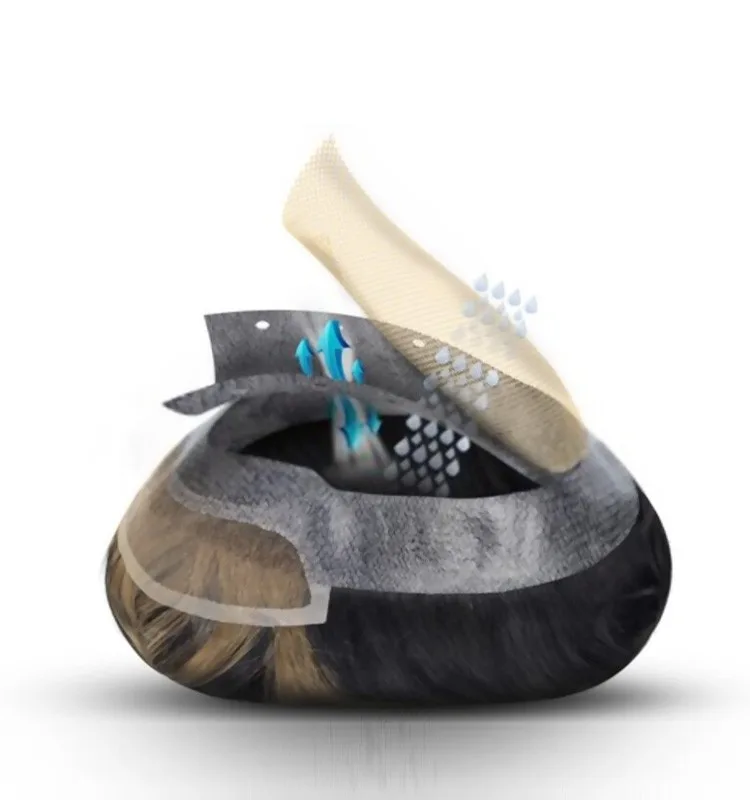
This is Neo Hair's speciality: an ultra-thin base that sits flat against the scalp and is designed to let air and water through. The aim is the clean look of a thin skin base with some of the breathability of lace. Like any very thin base, it needs gentle handling, and it will not outlast a thick mono base.
Mono bases
Monofilament, usually called mono, is a fine but firm mesh. It is the most durable of the common bases and keeps its shape through many cleanings. The scalp shows through it, which makes it good for partings and the crown.
The trade-off is the front. A mono edge is less fine than lace or thin skin, so mono systems usually get a lace or skin front, plus a poly border so that tape has something to grip.
Hybrid bases: lace front with a skin perimeter
A hybrid puts each material where it does the most good. Common combinations are:
- a lace front and centre with a thin-skin perimeter
- a mono centre with a lace front and a poly border
- a thin-skin front with a lace centre
The logic is the same each time: the most realistic material where people look, a breathable centre, and a durable edge where the bond is made and removed. For many daily wearers a hybrid is the sensible middle. Its weakest part sets its lifespan, and that is usually the lace front.
Hair system base types compared
| Base | Front hairline | Breathability | Durability | Usual attachment | Suits |
|---|---|---|---|---|---|
| Swiss lace | Most invisible | Very high | Low | Liquid adhesive | Close-up realism, heavy sweating |
| French lace | Very natural | High | Low to medium | Liquid adhesive | A first lace system |
| Ultra-thin skin (0.03–0.06 mm) | Invisible, no knots | Low | Low to medium | Tape or adhesive | A skin-like look, careful wearers |
| Nanotechnology ultra-thin | Invisible, no knots | Designed to let air and water through | Low to medium | Tape or adhesive | A skin-like look with better airflow |
| Thin skin (0.08–0.12 mm) | Natural at normal distance | Low | Medium to high | Tape | Self-maintenance, swimmers |
| Mono with poly border | Less fine without a lace front | Medium | High | Tape on the border | Durability, partings |
| Hybrid | Lace or skin front | Medium to high | Medium | Adhesive at the front, tape around | Most daily wearers, active lives |
Which hair system base is best for sweating, sport and hot climates?
Heat causes two problems. Sweat trapped under a base that cannot breathe loosens the adhesive and makes the scalp itch. And warmth softens some adhesives, so the edges start to lift.
For a Gulf summer, daily training or outdoor work, the usual answer is a breathable centre (lace or a permeable ultra-thin base) with a sweat-resistant liquid adhesive. A thin-skin perimeter around that centre keeps the bonding area easy to clean. Expect to re-bond closer to every two weeks than every five.
Air conditioning helps less than people expect. If you sweat heavily in the gym every evening, the temperature of your office during the day hardly matters.
Swimming depends more on the bond and the aftercare than on the base. Our guide to swimming, gym and sleep with a hair system covers that.
Tape or glue: which attachment suits which base?
Tape is double-sided medical tape cut to the shape of the perimeter. It is quick, clean and easy to remove, and it bonds best to skin and poly borders. It is less invisible at the very front and can lose grip sooner under heavy sweat.
Liquid adhesive is brushed on in a thin layer. It grips lace well, is invisible at the hairline and usually holds longer, but it takes more work to remove and clean off.
Many wearers use both: liquid adhesive along the front hairline, tape around the sides and back. The adhesives and tapes Neo Hair uses are skin-friendly, hypoallergenic medical products, and the choice between them is made at the fitting.
How to choose: four questions to answer first
- How close do people get to your hairline? A partner, a barber, a camera at work. The closer they get, the more lace or ultra-thin skin at the front is worth.
- How much do you sweat, and where do you live? Heavy sweat points to a breathable centre and liquid adhesive.
- Who will maintain it? If you will do it yourself at home, a skin perimeter is much easier to clean than lace.
- What can you spend in a year? Thin bases need replacing more often, so a lower price per system can cost more over time.
For lifespan figures by base, see how long a hair system lasts. Men and women choose from the same bases, though women's systems put more weight on the parting; the women's hair systems page covers that. Send a few photos over WhatsApp and we will recommend a base for your scalp, climate and routine as part of a free hair analysis.